
Integrated biogas generation, digester safety, flow metering and gas-quality measurement for South African waste-to-energy projects
On 17 and 18 June 2026, Energas Technologies joined project. Developers, plant operators and technology partners at BIO360 AFRICA 2026 at Gallagher Convention Centre. Energas participated from the Southern African Biogas Industry Association (SABIA) stand B26, where the programme explored practical biogas project pathways across the agricultural, industrial and municipal sectors.
The event reinforced a practical point: a successful biogas plant needs more than a digester. The gas must be safely contained, conditioned to the required specification, accurately measured and converted into useful electricity and heat.
South African opportunities include anaerobic digestion of livestock manure and agricultural residues, wastewater sludge, food and beverage waste, industrial effluent and other organic biowaste, as well as landfill-gas recovery. For organisations searching for a biogas equipment supplier in South Africa, Energas combines internationally proven technology with local engineering, equipment supply, product support and maintenance.
Enertec biogas generators and CHP for South Africa
At the conversion end of the plant, R Schmitt Enertec’s ENERGIN gas generator sets and combined heat and power (CHP) units turn biogas into dependable on-site energy. The current 50 Hz biogas range covers 140 kW to 500 kW of electrical output, with electrical efficiencies up to 42.7%, depending on the selected model.
ENERGIN GEN units are designed for electricity generation in island mode or parallel with other generators and the utility. Where heat is valuable, ENERGIN GEN+ recovers heat from the engine cooling circuits, while the CHP configuration also captures exhaust heat. The recovered thermal energy can be used for digester heating, process hot water or other site heat demands. Current biogas CHP models achieve overall efficiencies of up to 86.6%, subject to model and operating conditions.
Because the ENERGIN range is modular and supplied as compact, pre-engineered equipment, it can support projects ranging from a single farm, factory or wastewater facility to multi-unit gas-to-power installations.
Gas conditioning protects long-term performance
Raw biogas does not necessarily need to be upgraded to pipeline-quality biomethane before it can fuel an engine, but it must comply with the engine manufacturer’s fuel specification. Moisture can cause corrosion and condensate; siloxanes can form abrasive deposits; and sulphur compounds, including hydrogen sulphide (H2S), can accelerate corrosion and wear.
The Enertec reference project supplied with this article uses multi-stage gas treatment comprising cooling and moisture removal, reheating and activated-carbon filtration. The correct treatment train is selected for the actual feedstock, gas composition and engine duty. This avoids unnecessary upgrading costs while protecting reliability, engine life and service intervals.
Protectoseal safety equipment for biogas digesters and tanks
Methane-rich biogas is flammable, and anaerobic digesters continuously produce gas. Safe operation therefore depends on correctly selected pressure and vacuum relief devices, emergency venting and flame protection.
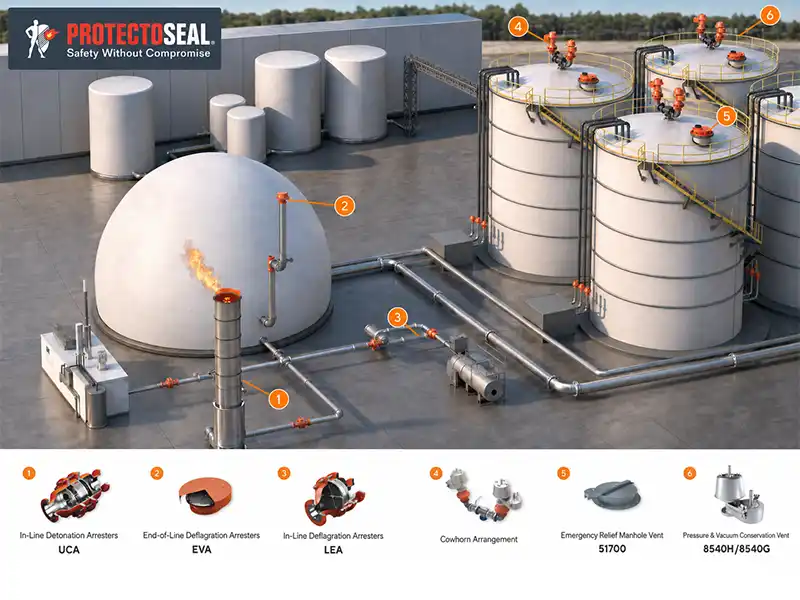
The Protectoseal FAB Valve Series integrates a pressure and vacuum conservation vent with an end-of-line deflagration flame arrester. The pressure function protects the vessel against excessive pressure, the vacuum function protects against damaging vacuum conditions, and the arrester helps prevent an external atmospheric deflagration from propagating into the tank. The series is type-tested to EN ISO 16852 and approved to the ATEX Directive.
Energas can also supply a broader range of Protectoseal biogas tank safety equipment:
- Cowhorn Arrangement: twin flame arresters and pressure/vacuum conservation vents on a three-way valve provide a duty/standby arrangement, allowing maintenance with minimal disruption to biogas production.
- In-line and end-of-line flame arresters: deflagration and detonation arresters are selected according to the possible flame event, piping configuration, gas group, temperature and initial pressure.
- Conservation and emergency venting: pressure/vacuum vents and emergency relief manhole vents protect digesters and storage equipment against abnormal pressure or vacuum conditions.
These are safety-critical devices. Final sizing and selection must consider the vessel’s allowable pressure and vacuum, normal and emergency venting rates, gas properties, potential blockage or foaming scenarios, hazardous-area requirements and the applicable codes and standards.
RMG biogas flow meters for process control and energy accounting
Accurate flow measurement supports process control, mass and energy balances, generator performance monitoring, flare accounting, biomethane injection and, where required, commercial or custody-transfer measurement.
RMG’s gas-meter portfolio includes turbine and ultrasonic technologies. The TRZ 03 turbine meter is available in special designs for aggressive gases such as biogas, using options such as PTFE lining, special materials and suitable lubrication. This makes project-specific material selection essential, particularly where H2S, moisture or other corrosive constituents may be present.
For adequately cleaned, dry and non-condensing gas, the RMG RSM 200 ultrasonic meter offers no moving parts, an integrated volume corrector, pressure and temperature measurement, data archiving, Modbus communication and battery operation for more than five years. Its stated gas limitations are important: the gas must be free of corrosive or aggressive components, liquids and solids. It is therefore better suited to conditioned gas or upgraded biomethane than to untreated, wet raw biogas.
RMG RGQ 5 gas-quality measurement for biogas and biomethane
Flow tells the operator how much gas is available; the RMG RGQ 5 gas-quality analyser helps determine its energy and combustion properties. Using patented viscometer technology and MEMS sensors, the RGQ 5 continuously calculates superior and inferior calorific value, upper and lower Wobbe Index, density, relative density, compressibility, air/fuel ratio and methane number. Optional sensors measure carbon dioxide and hydrogen.
The RGQ 522 Renewable variant adds CO2 measurement and was developed for applications including biomethane injection, combustion control and gas-network monitoring. It provides rapid measurements, has no moving parts, requires no carrier gas and can communicate through 4-20 mA and Modbus RTU. The latest RMG literature states a measurement uncertainty of up to 1% of the measured value.
As with every analyser, the sample must fall within the approved composition and condition limits. The RGQ 5 literature specifies methane-rich gas, does not tolerate dust or liquid, and limits water and H2S content. Raw biogas may therefore require filtration, drying or upgrading before analysis. Energas can help assess whether the sample is suitable and define the required sample-conditioning arrangement.
Why an integrated biogas equipment strategy matters
A biogas generator, flame arrester, safety valve, flow meter or gas analyser should not be selected in isolation. Gas composition, H2S and siloxane concentrations, moisture, solids, pressure, temperature, flow range, hazardous-area classification, explosion gas group, required turndown and maintenance philosophy all influence the final equipment specification.
Considering the full gas train early in the project helps developers match the gas-cleaning system to the generator, protect the digester and pipework, choose a meter that suits the actual gas condition, and measure the quality parameters needed for stable operation or biomethane export.
A South African partner for biogas equipment and support
Energas Technologies has supplied engineered gas infrastructure and gas-to-power solutions to Southern African industry since 2001. Our offering combines equipment selection, engineering support, supply, commissioning assistance and after-sales service. Energas technicians are trained to support Enertec engines, including units already operating in Gauteng.
Whether the project involves agricultural biogas, wastewater-to-energy, industrial effluent, food waste, landfill gas, on-site electricity generation, CHP or biomethane, Energas can help define the equipment required to move safely and efficiently from gas production to usable energy.
Thank you to everyone who connected with Energas at the SABIA stand B26 during BIO360 AFRICA 2026. We look forward to supporting the next generation of safe, measurable and bankable biogas projects in South Africa and across the region.